Published on 25 Nov 26
Background
Antibody-drug conjugates (ADCs) have emerged as an important class of targeted therapeutics, combining the antigen specificity of monoclonal antibodies with the potent cell-killing activity of cytotoxic payloads. The successful development of an ADC requires demonstrating target recognition, efficient internalization and intracellular processing, and delivery of sufficient payload to produce the desired pharmacological effect. Consequently, a comprehensive strategy for ADC bioassay services should evaluate multiple stages of the mechanism of action—from target binding to cellular internalization and functional cytotoxicity.
Rationale for Kadcyla (T-DM1) as Benchmark ADC model
To support ADC discovery and preclinical development, o2h Discovery has established an integrated ADC bioassay platform comprising target-binding assessment by surface plasmon resonance (SPR), cellular internalization, and functional cytotoxicity assays. The platform was benchmarked using trastuzumab emtansine (T-DM1; Kadcyla), an FDA-approved HER2-targeting antibody – drug conjugate (ADC), and its unconjugated parental antibody, trastuzumab.
Kadcyla was selected as a model ADC based on its well-characterized mechanism of action and established clinical use in HER2-positive breast cancer. T-DM1 consists of the humanized anti-HER2 IgG1 antibody trastuzumab conjugated to the microtubule-inhibitory payload DM1 through the stable thioether linker SMCC. Upon binding to HER2, T-DM1 undergoes receptor-mediated internalization and lysosomal degradation, leading to the release of DM1-containing cytotoxic catabolites that disrupt microtubule function and induce cell death.
Trastuzumab served as a comparator to evaluate the effects of SMCC-DM1 conjugation on HER2-binding affinity and cellular internalization, while establishing the contribution of the cytotoxic payload to the functional response. The studies aimed to demonstrate that linker-payload conjugation preserves the antibody’s target-binding and internalization properties while conferring enhanced cytotoxic activity in HER2-positive cells.
Characterizing HER2 Binding Affinity of T-DM1 and trastuzumab using SPR
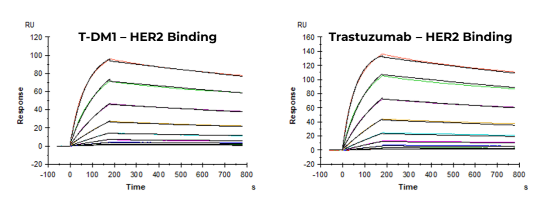
Preservation of HER2-binding affinity following linker-payload conjugation is an important aspect of ADC characterization. To assess the impact of DM1 conjugation on antibody-binding affinity and kinetics, SPR analysis was performed using a Biacore T200 system, allowing real-time characterization and comparison of HER2 interactions with T-DM1 and unconjugated trastuzumab.
|
HER2 SPR – Kinetic parameters (1:1 binding) |
||||
|
ADC/mAb |
ka (1/Ms) |
kd (1/s) |
KD (nM) |
Chi² (RU²) |
|
T-DM1 |
1.05E+05 |
3.30E-04 |
3.13 |
0.282 |
|
Trastuzumab |
1.33E+05 |
3.17E-04 |
2.39 |
1.520 |
Cellular Internalization: Assessing Receptor-Mediated Uptake
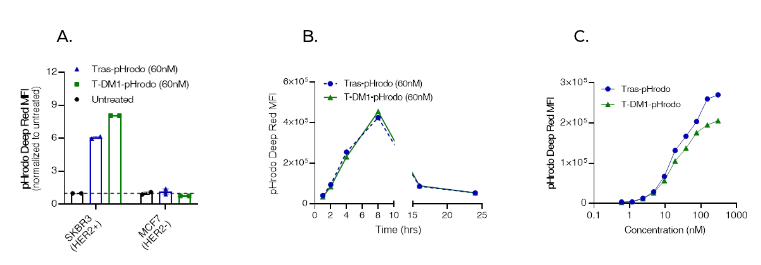
Following HER2 binding, receptor mediated internalization is a critical step in the mechanism of action of T-DM1, enabling intracellular delivery and processing of the conjugated payload. We evaluated cellular uptake of T-DM1 in SK-BR-3 (HER2+) and MCF7 (HER2-) cells to characterize target-associated internalization. T-DM1 and trastuzumab were covalently labelled with pHrodo Deep Red, a pH-sensitive dye that is non-fluorescent at neutral pH and fluoresces only in acidic intracellular compartments (late endosomes, lysosomes). This allows us to monitor real time internalization and trafficking of T-DM1 to lysosomes for payload release. Flow cytometry was used to assess uptake, compare internalization kinetics and evaluate concentration dependence.
Functional Cytotoxicity: Demonstrating Payload-Dependent Activity
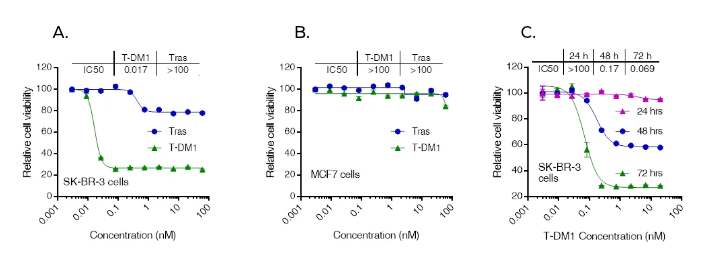
To establish the functional efficacy of T-DM1 beyond target binding and cellular internalization, its cytotoxic activity was evaluated using the CellTiter-Glo assay in HER2-positive SK-BR-3 and HER2-negative MCF7 cells. The unconjugated parental antibody trastuzumab served as a comparator to distinguish DM1 payload-dependent cytotoxicity from antibody-mediated effects and assess the HER2 dependence of ADC activity.
Supporting ADC Development Through Integrated Bioassay Solutions
Successful ADC development requires a clear understanding of how an antibody-drug conjugate binds to its target, undergoes cellular internalization and delivers its cytotoxic payload. The studies using T-DM1 demonstrate how an integrated bioassay approach can help evaluate these key aspects of ADC activity, from HER2 binding affinity to intracellular uptake and payload-dependent cytotoxicity.
At o2h Discovery, we offer integrated ADC bioassay capabilities to support the characterisation and evaluation of antibody-drug conjugates throughout drug discovery and preclinical development.
Looking to evaluate your ADC candidates? Get in touch with our team to discuss your bioassay requirements and explore how our integrated capabilities can support your ADC development programmes. Contact us today at discovery@o2h.com or visit: www.o2hdiscovery.co/contact/